Communication Sciences and Disorders (B.S.)
We’re in the news!
Learn how one of our faculty is advancing communication solutions for children with brain-based visual impairments in Q&A: Customizing Communication for Children with Visual Impairment
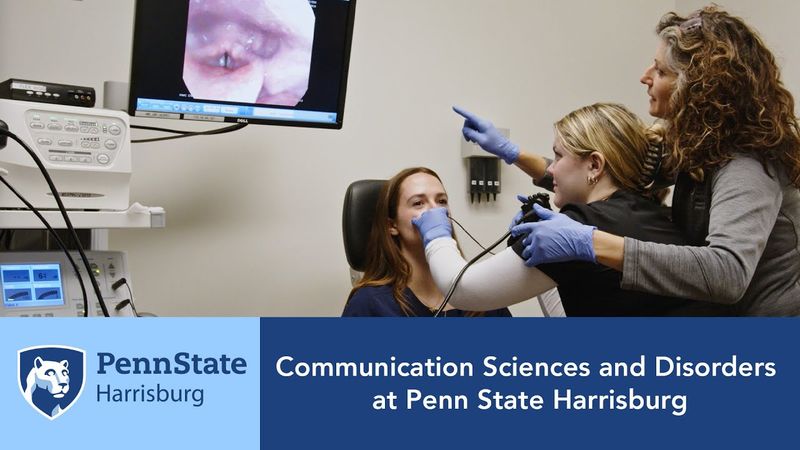
Communication Sciences & Disorders (CSD) is the undergraduate major which prepares students who wish to attend graduate school in order to become speech-language pathologists (SLPs) or audiologists. The program helps students acquire a strong foundation in the basic sciences and processes related to typical, delayed and disordered speech, language, cognition, swallowing, and hearing. Students gain critical-thinking abilities necessary to apply foundational knowledge and skills to the identification, assessment, and treatment of communication and swallowing disorders.

Nearly all students who complete the undergraduate degree in CSD continue on to graduate school, pursuing a degree in either SLP or audiology. Graduate degree programs in SLP are typically completed in two years, while students interested in audiology need to complete a clinical doctorate (Au.D.), which typically takes an additional year. To date, there are over 300 SLP graduate programs and 80 Au.D. programs in the U.S.
Careers that make a difference
Speech-Language Pathologists and Audiologists help people with a variety of deficits in communication, hearing, balance, and swallowing. Our work has a positive impact on peoples’ lives in so many ways and the career is very rewarding.
Students who complete a graduate degree in SLP evaluate, diagnose and provide treatment for people of all ages who have communication disabilities and differences, as well as swallowing disorders (dysphagia). Speech-language pathologists work in hospitals, rehabilitation centers, schools, community clinics, nursing homes, and private practice.
Audiology students who complete the Au.D. evaluate, diagnose and treat people of all ages with hearing loss and vestibular (balance) problems. Speech-language pathologists and audiologists who earn doctorate (Ph.D., Ed.D.) degrees typically teach and conduct research in a university setting but can also work and conduct research in a clinical setting.
Both careers offer immense salary potential and employment growth. According to the U.S. Bureau of Labor Statistics, employment of speech-language pathologists is projected to grow 19% from 2022 to 2032, and 11% for audiologists during this same period. Median pay is over $84,000 for both of these careers. Regardless of which path you choose, the CSD major is your first step to a rewarding career.
Not sure which career path may be right for you? Take the Quiz to see which career best fits your personality!
Start your journey towards a career in speech-language pathology or audiology. Contact us at [email protected] today!

