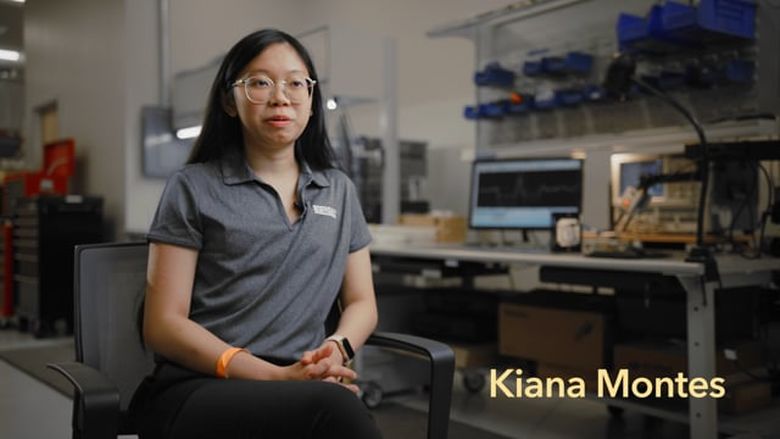
The EE BS program helps its graduates develop capabilities to analyze and design a variety of electrical and electronic systems found in many industrial and government settings as well as providing a foundation for further graduate studies. A strong background in the fundamentals is built through a broad-based core in basic sciences (physics and chemistry) and mathematics as well as engineering sciences.
Areas of Interest
By selecting your Technical Electives appropriately (see below), you may tailor your Electrical Engineering degree toward any of several optional areas of interest:
Biomedical Devices and Systems
We offer several technical electives in topics such as Image Processing and Computer Vision, Biomedical Instrumentation, and Medical Imaging.
Communications Systems
Combining the required course in Communications together with technical electives in Communication Systems, Optical Fiber Communications, Electromagnetic Fields, RF and Microwave Engineering, and/or Antenna Engineering will prepare you well for jobs working with Communications Systems.
Communication Theory and Signal Processing
Penn State Harrisburg sits within the "Connector Capital of the World," with more than 25 electrical connector companies in the Harrisburg metropolitan area. Prepare for employment at these and other companies by taking courses in Signal Integrity, Digital Signal Processing, and/or Digital Image Processing.
Control Systems and Robotics
Some students choose to complete a Mechatronics Minor as they complete their degree in Electrical Engineering. If you choose not to, you can gain valuable experience by taking courses described on that page and in Control Systems, Automation and Robotics Systems, and/or Power System Analysis.
Electronics
If you're seeking experience in designing electronics, choose electives in Linear Electronic Design, Power Electronics, and/or Digital Integrated Circuit Design.
Electric Drives, Power, and Energy Systems
Many employers are actively seeking workers with expertise in electronic power systems. At Penn State Harrisburg, you may choose electives in Energy Systems and Conversion, Power System Analysis, and/or Power Electronics.
Very Large Scale Integration (VLSI)
VLSI describes how integrated circuits, which include millions or billions of transistors on a single chip, are designed and made. To gain expertise in this field, select electives in Digital Integrated Circuit Design and/or Semiconductor Integrated Circuit Technology.
Technical Electives
- Each student in the Electrical Engineering program is required to take 11-12 credits of Technical Electives. You may use these either to further develop your understanding of the material in a required course, or to explore material in a specialty that you are interested in (and may apply to your career).
- Any 400-level course in Electrical Engineering that is not already required for the major may be used to satisfy this requirement. You may substitute up to 3 credits of SSET 495 (internship) or many other 400-level science and engineering courses. Consult with your advisor well ahead of time if you plan to use anything other than a 400-level EE course to satisfy this requirement - it may involve a petition to the program faculty.
- Please register for your technical electives as soon as they become available: if the enrollment is too low, the one you're most interested in taking may be cancelled.
Internships
Whatever your major, it is useful to get real-world experience in your field: it allows you to understand what the work is like and the talents required to succeed, and it shows a potential future employer that you're interested in and capable of succeeding.
To provide this experience, the Electrical Engineering program requires everyone in the major to complete one credit of internship prior to graduation. Each student must be registered for SSET 295 at the time the internship starts, and a minimum of 90 hours of work experience is required. During this time, you should expect periodic progress reviews; and an evaluation form must be completed after the first two weeks, midpoint, and at the conclusion of the internship.
Students in Electrical Engineering may complete up to an additional 3 credits of internship (SSET 495), requiring a minimum of 270 hours of work experience (3 credits times 90 hours per credit). These credits may serve as a technical elective.
Typically, these credits are taken during the summer, when there is a greater opportunity to find paid internships at local employers that do not conflict with classes. But that is not required, as long as the work hours and reporting requirements are met.
For students unable to coordinate an internship with a company, it is possible to arrange to do equivalent work (with the same hourly and reporting requirements) with a faculty member on campus.
This program is accredited by the Engineering Accreditation Commission of ABET, under the General Criteria and the Electrical and Electronics Engineering Program Criteria.
This page is not a part of the official Penn State University Bulletin.